Fine binding
Leather book binding by hand
You only have to pick up a well-bound book to see why the traditional aspects of the craft are so important.
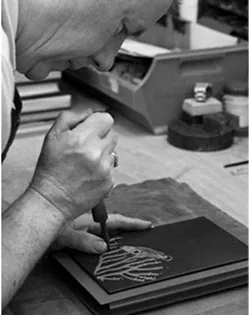
Hand-gilded edges, beautifully grained and polished leathers, silk headbands, hand tooling in gold leaf: these are the ingredients of a well-bound book.
At Sangorski & Sutcliffe we combine traditional techniques with contemporary designs to create modern innovative bindings.

Traditional styles
From full cloth to full leather extra
A choice of traditional binding styles, shown on our sample books. Select a style to see it larger.

1. Full cloth

2. Half leather, cloth sides, blind lines

3. Half leather, cloth sides, gilt lines

4. Half leather, marble paper sides, gilt lines

5. Half leather, marble paper sides, full gilt spine

6. Full leather, one line panel on boards
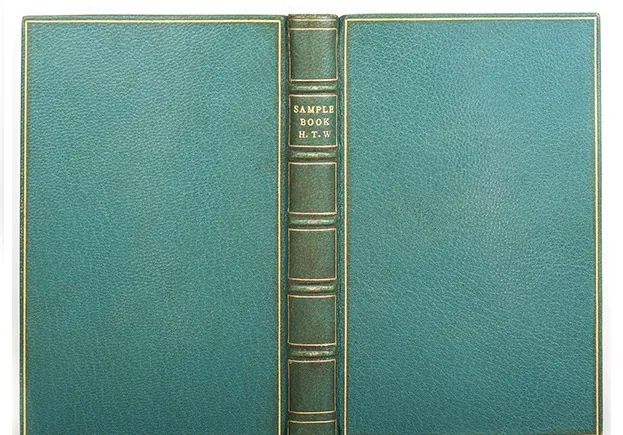
7. Full leather, one line panel on boards and spine

8. Full leather, full gilt spine, two line panels to the boards

9. Full leather, full gilt decoration to boards and spine
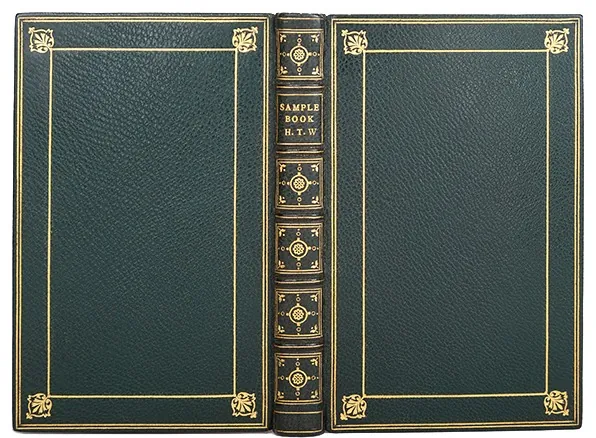
10. Full leather, extra full gilt

12. Cambridge panel
Contemporary fine binding
Fine binding is an art form
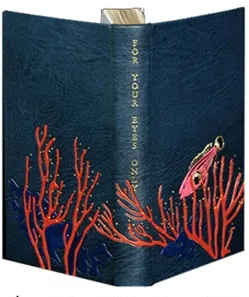
The combination of traditional techniques and modern design concepts is one of the most exciting aspects of contemporary fine binding.
We work closely with our clients to create beautiful bindings that interpret both the contents of the book and reflect our customers’ design tastes.
Sangorski & Sutcliffe have been creating design bindings since 1901. Take a look at some of our latest creations.
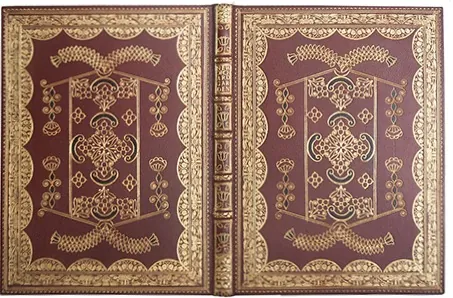
Contemporary designsA ‘period style’ binding by Daniel Wray
A New Orchard and Garden, 1648
Lawson, William; A New Orchard, and Garden: or the best way for planting, grafting, and to make any ground good, for a rich orchard; particularly in the north, and generally for the whole kingdom of England… London, printed by W. Wilson for John Harison, 1648. Printed together with the first horticultural book written solely for women, The Country Housewife’s Garden.
The book is bound in hand-dyed goatskin and decorated in a late 17th century style of gold tooling.
A skilful repair has been made to the final line of the title-page, the missing letters having been copied from the British Library copy and printed from a zinc block. The missing text has been grafted on to the bottom edge of the title-page.

Modern design binding by Eri Funazaki and John Goss
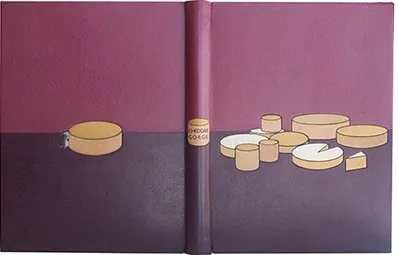
Cheddar Gorge: A Book of English Cheeses
Shepherd, E.H. London: Collins, 1937. This edition is limited to 220 copies, this one number 85, each of which is signed by the editor, John Squire, and the artist, Ernest H. Shepard. Illustrated with 35 line drawings by Ernest Shepard.
Bound in two pieces of goatskin, a rich crimson red on the top half of the book and a dark burgundy on the lower section, the two leathers joined in a horizontal line across the middle of both boards and spine. The front and back boards are decorated with a formal pattern of round and wedge shaped cheeses created in cream coloured calfskin and tan goatskin onlays. A tiny grey mouse peeks from a round cheese on the back board.
Enquiries
Talk to the bindery
To enquire about our full range of services, please contact the Managing Director, Alison Strachan, or Daniel Wray, who is in charge of the Conservation & Restoration Department.